%20(2).png?width=100&height=97&name=Inverted%20Logo%20(1)%20(2).png "TSG")

.png)
.png)
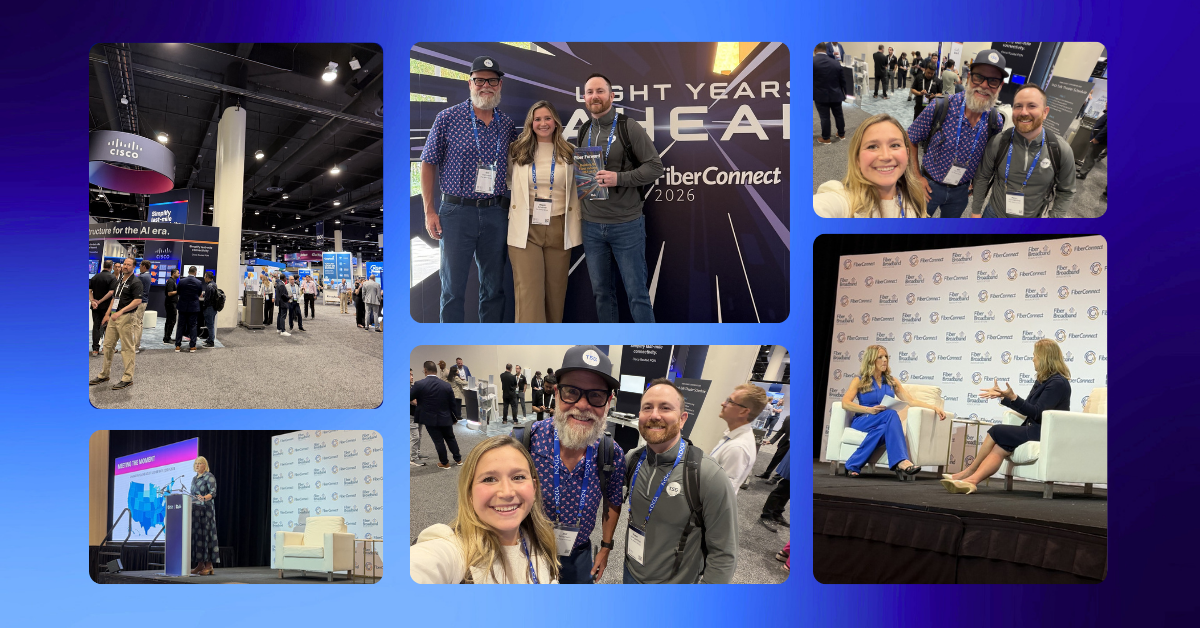
Walking into Fiber Connect 2026, there was an unmistakable sense that the broadband industry is entering a very different phase of growth.
For years, much of the conversation centered around expansion. Build faster. Pass more homes. Extend networks further. Increase coverage. But this year, the tone shifted. The conversations felt more operational, more strategic, and in many ways, more urgent.
The industry is no longer asking whether broadband expansion will continue. That answer is already clear. The real question now is whether organizations can operationalize growth at the scale and speed the market now demands.
Across keynote sessions, customer discussions, and hallway conversations, one reality surfaced repeatedly. Telecom and broadband providers are facing mounting pressure to modernize not only their networks, but also the operating models, data environments, workflows, workforce structures, and execution processes surrounding them.
At TSG, this year’s event reinforced what we have increasingly seen across the market. Network deployment is no longer just an infrastructure challenge. It is an execution challenge, a data challenge, a workforce challenge, and increasingly, an AI readiness challenge.
As Megan Schulman, Managing Director of Telecommunications at TSG reflected after the event:
“The conversations felt much more grounded in execution this year. Organizations are realizing that scaling broadband successfully requires far more than construction volume alone. Visibility, coordination, workflow maturity, workforce readiness, and operational sustainability are becoming just as important as the network itself.”
That theme carried through nearly every conversation at the conference.
The industry is feeling the weight of execution complexity
Fiber deployment remains one of the most significant priorities across the telecom market. Yet despite the momentum surrounding broadband expansion, many organizations are still struggling with the operational realities of scaling effectively.
Permitting delays continue to slow projects. Engineering coordination remains difficult across large ecosystems of vendors and contractors. Workforce shortages are creating pressure on delivery timelines. Reporting visibility often remains fragmented across teams and systems. Even organizations with strong funding and aggressive growth targets are discovering that execution becomes exponentially harder as deployment scales.
One of the clearest observations from the event was that many providers are reaching a point where simply adding more vendors or resources no longer solves the problem.
The issue is orchestration.
Organizations are trying to figure out how to improve coordination between engineering, permitting, construction, field operations, reporting, and leadership visibility while still accelerating deployment schedules.
Megan noted that this operational strain surfaced repeatedly throughout conversations at the event.
“There’s growing recognition that broadband expansion cannot scale sustainably without stronger operational alignment across the full deployment lifecycle,” she explained. “A lot of organizations are trying to reduce friction between teams, improve reporting visibility, and create more repeatable execution models.”
That reality also elevated discussions around outside plant execution and engineering standards.
Several keynote sessions emphasized how poorly managed workflows, inconsistent engineering quality, weak make-ready preparation, and permitting inefficiencies can quietly create enormous downstream operational burdens. While those issues may initially appear manageable, they often compound over time through project delays, rework, increased costs, operational inefficiencies, and scalability challenges.
TSG’s Pete Spangenthal, Vice President, Communications, pointed to one keynote discussion around OSP standards as particularly impactful.
“One of the things that really stood out to me was the conversation around operational discipline and OSP quality,” Pete said. “High-quality designs, reduced permitting friction, and stronger make-ready preparation do far more than accelerate deployment. They reduce hidden operational costs that many organizations do not fully recognize until those inefficiencies begin slowing down the business.”
That insight captured one of the strongest themes emerging from Fiber Connect 2026.
Execution quality is becoming a competitive differentiator.
Organizations that improve operational visibility, workflow coordination, engineering consistency, and delivery discipline will be significantly better positioned to scale efficiently as demand continues accelerating.
AI conversations have shifted dramatically
Artificial intelligence dominated many conversations throughout the event, but the tone around AI has evolved considerably from previous years.
Not long ago, AI discussions often focused on tools, experimentation, or future possibilities. This year, the conversations felt much more practical and operational.
Organizations are beginning to recognize that AI success depends far less on the technology itself and far more on the condition of the environment surrounding it.
Sessions centered around agentic AI, automation, telemetry, orchestration, governance, and digital twins repeatedly highlighted the same underlying challenge. Many organizations are not yet operationally prepared to support meaningful AI adoption at scale.
As Megan observed:
“A lot of companies are excited about AI, but there’s also a growing realization that many existing environments are not fully prepared for it. Data quality, workflow maturity, documentation, governance, and operational consistency all became major parts of the conversation.”
That shift matters because it reframes AI from a technology initiative into an operational transformation initiative.
The question is no longer simply: “What AI tools should we use?”
The question is increasingly: “How do we prepare our organization to operate effectively in an AI-enabled environment?”
That distinction surfaced repeatedly throughout the conference.
Agentic AI discussions in particular illustrated how much organizational complexity lies ahead. The concept of multiple AI agents operating across workflows, ticketing systems, field environments, and operational processes introduces enormous potential. It also introduces significant governance, coordination, and readiness challenges.
Organizations are beginning to understand that AI adoption will require modernized workflows, cleaner operational data, stronger governance models, and greater cross-functional alignment than many environments currently support.
The AI infrastructure race is accelerating
Beyond AI software and operational workflows, Fiber Connect also highlighted growing urgency surrounding infrastructure readiness itself.
Discussions around GPU capacity, edge compute, data center scalability, transport infrastructure, and AI-enabled workloads created a clear sense that the industry is entering a critical infrastructure planning window.
Pete noted that the momentum surrounding GPUs and edge infrastructure was impossible to ignore.
“You could really feel that the next 18 months are critical for the industry,” Pete explained. “Everyone is thinking about GPUs and what future AI demand is going to require from network infrastructure, especially as compute moves closer to the edge.”
That urgency is reshaping infrastructure planning conversations across telecom environments.
Providers are increasingly evaluating how network architecture, edge compute accessibility, transport capacity, and data center ecosystems will evolve together as AI demand accelerates.
The implications extend far beyond traditional connectivity conversations. Organizations are now balancing:
- latency reduction
- compute accessibility
- cooling and power constraints
- infrastructure scalability
- transport engineering
- and long-term operational sustainability.
- improve visibility
- reduce operational friction
- strengthen coordination
- accelerate deployment
- modernize workflows
- prepare for AI adoption
- and create more resilient operational models capable of supporting future growth
The middle mile has reentered the spotlight
One of the more surprising themes at Fiber Connect 2026 was the renewed emphasis on middle-mile infrastructure.
Historically, many broadband discussions have focused heavily on last-mile deployment. This year, however, providers appeared much more focused on how middle-mile modernization directly impacts latency, network efficiency, AI readiness, and future scalability.
Pete noted that the level of focus surrounding middle-mile strategy felt dramatically different than previous years. “The focus on the middle mile was unlike anything I’ve seen before at this event,” he said. “Providers are recognizing that supporting future AI demand and reducing latency requires stronger connectivity layers and more off-ramps that may not have been prioritized in earlier network builds.”
That shift reflects how rapidly infrastructure priorities are evolving.
Broadband expansion is no longer simply about extending access. Increasingly, providers are trying to create intelligent infrastructure ecosystems capable of supporting next-generation digital services, AI workloads, edge computing environments, and long-term operational flexibility.
Digital twins are exposing the importance of data foundations
Digital twins emerged as one of the most discussed concepts throughout the conference, signaling how quickly telecom organizations are shifting toward more intelligent and predictive operational models.
The ability to model network behavior virtually before making live infrastructure changes represents a compelling vision for the future of telecom operations. Discussions throughout the event focused on how digital twins could improve network reliability, accelerate testing, strengthen operational visibility, support predictive maintenance, and reduce risk across increasingly complex infrastructure environments.
At the same time, many of the conversations exposed a much deeper industry challenge.
Digital twins depend entirely on strong operational and data foundations.
Organizations need accurate inventory data, topology alignment, telemetry visibility, process consistency, and integrated operational systems before digital twin initiatives can deliver meaningful value at scale. Several sessions reinforced that many providers are still working through fragmented data environments, disconnected systems, inconsistent documentation, and operational silos that make advanced modeling difficult to operationalize effectively.
As a result, conversations around digital twins frequently became conversations about operational readiness, data maturity, and foundational modernization.
The broader takeaway from the event was clear: telecom modernization is increasingly becoming a data modernization challenge as much as a network challenge. Organizations looking to operationalize AI, automation, and predictive infrastructure management will first need to strengthen the quality, visibility, and alignment of the environments supporting those initiatives.
Broadband providers are expanding their role in communities
Another notable shift throughout the event was the growing emphasis on digital inclusion, education, workforce development, and community engagement.
Several discussions highlighted how providers are trying to position broadband expansion as part of a broader ecosystem tied to economic development, learning opportunities, healthcare access, and future workforce readiness.
Programs centered around STEM education, esports initiatives, digital learning environments, and community partnerships illustrated how providers are attempting to differentiate themselves beyond pure connectivity.
As Megan noted:
“There was a noticeable shift toward discussing broadband as part of a larger community and economic development conversation. Providers are looking for ways to create stronger engagement models and connect broadband expansion to long-term regional impact.”
That evolution reflects how the market itself is maturing.
Success is no longer measured solely through homes passed or subscribers added. Increasingly, organizations are evaluating how broadband initiatives contribute to broader community outcomes and long-term adoption.
What Fiber Connect reinforced for TSG
Perhaps the most important takeaway from Fiber Connect 2026 was how deeply interconnected the industry’s challenges and priorities have become.
Network deployment can no longer be separated from operational visibility. AI readiness is now directly tied to data maturity and workflow consistency. Infrastructure scalability increasingly depends on workforce enablement, execution discipline, and the ability to coordinate across fragmented systems, vendors, and operational teams.
What became clear throughout the conference is that telecom and broadband organizations are no longer modernizing one function at a time. They are attempting to modernize entire operating environments simultaneously while continuing to scale network expansion under increasing pressure.
For TSG, the event reinforced the growing importance of helping providers navigate that complexity through scalable execution support, operational modernization, technology-agnostic delivery models, and sustainable long-term operating strategies.
Across nearly every conversation, organizations were searching for ways to:
The market is increasingly looking beyond traditional capacity augmentation alone. Providers are searching for partners who understand how to bridge strategy, execution, operations, and adoption in environments where infrastructure, data, AI, and customer experience are all evolving at the same time.
As one theme consistently surfaced throughout Fiber Connect, it was this: modernization is no longer a single initiative. It is an ongoing operational transformation effort that touches every part of the business.
That convergence will likely define the next phase of broadband and telecom transformation. And as providers continue navigating rapid infrastructure growth, evolving AI demands, workforce pressures, and increasing operational complexity, the organizations best positioned for long-term success will be the ones capable of turning complexity into scalable execution.
To learn more about how TSG supports telecom and broadband organizations through operational modernization, infrastructure execution, AI readiness, and scalable delivery support, contact our experts to continue the conversation.
Latest insights, in your inbox
Subscribe now to receive the latest news and insights from TSG.