





EBOOK
The execution gap in utilities
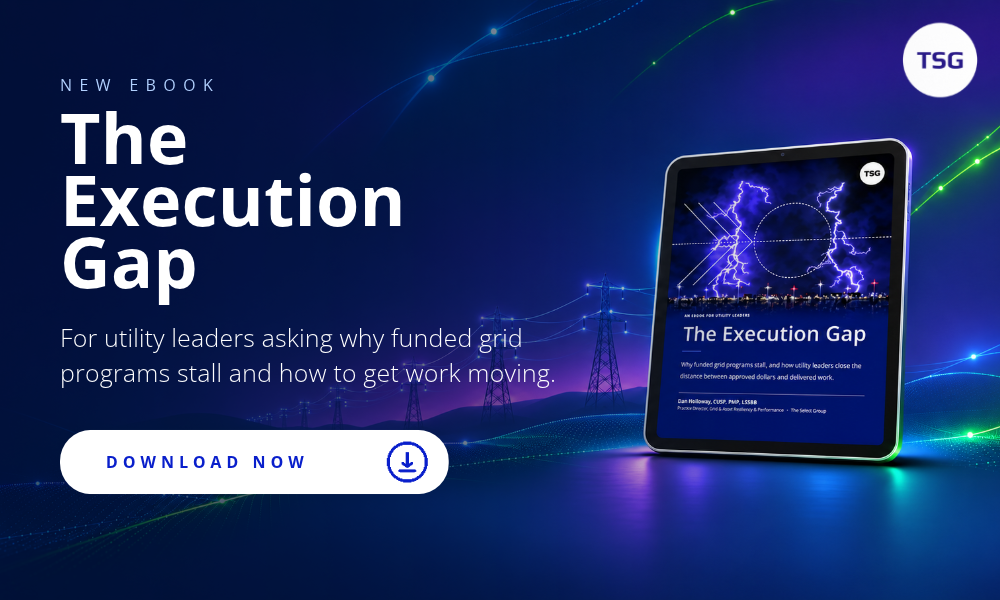
Grid resilience dollars are flowing to municipal utilities and cooperatives like never before. So why do approved projects keep rolling into next year? The Execution Gap shows you where delivery breaks down, and how the best operators close the distance.
.png)
Download free eBook
You can't buy, hire, or consult your way out.
Most utilities reach for one of three fixes. Each helps a little. None of them closes the gap on its own.
More people ≠ more delivery
The market for experienced utility talent is empty at the senior level. And headcount alone doesn’t fix unclear ownership or competing priorities.

New software ≠ new results
A platform without discipline produces exactly one thing: a very expensive dashboard displaying the same slipped dates you used to see in spreadsheets.

A big-firm strategy ≠ execution
Global consultancies write excellent strategy decks, but few have worked at the scale of a municipal system or co-op. Recommendations don’t deliver themselves.
What closes the gap is something your industry already knows how to do. It only does it during storms.
Funded isn't finished.
The execution gap is the distance between what your utility has committed to deliver and what it can actually build, at the pace, cost and standard of evidence the commitment requires. It’s not a funding problem. It’s not a technology problem. And it shows up in four ways you’ll recognize.
Any one of these is a project problem. All four together is an organizational condition.
Money that won’t leave the building
Approved capital rolls into next year’s budget, again.
Costs that outrun the plan
Real unit costs drift further from the rate study every year.
The evidence scramble
Benefits you have to prove to a board, a council or a grant administrator, in writing, after the fact.
The same lesson, every storm
The after-action report reads like last year’s, because last year’s findings never closed.

What's inside?
The money is approved. The hard part now is turning it into delivered, documented work. Dan Holloway draws on 30 years in the industry, from apprentice lineman to executive leadership.
-
A name for the problem you've been feelingThe four warning signs, and why most leadership teams misread them as one-off project problems.
-
The three walls holding you backA retiring workforce, an affordability ceiling and a delivery machine built for a different era. Attack one in isolation and the other two absorb the gain.
-
Six practices proven in the storm roomCommand structure, one operating picture, corrective-action closure, a benefits evidence chain, surge capacity by design, and bringing retired expertise back inside the fence.
-
A diagnostic you can run this quarter
Ten questions to ask your own leadership team. How long the answers take is itself a finding.
ABOUT THE AUTHOR
Written by someone who's run the storm room
Dan Holloway, CUSP, PMP, LSSBB · Practice Director, Grid & Asset Resiliency & Performance, TSG
Dan has spent more than three decades in the electric utility industry. He started as an apprentice in 1994 and worked his way through journeyman, working foreman and senior project management roles into executive operations and safety leadership at one of the nation’s largest utilities. He’s also a U.S. Army veteran. This book is what running storms taught him about running everything else.
Already know you have a gap?
Skip ahead. The Storm Resiliency Assessment is a three-week, fixed-fee engagement with two days on site, sized so a general manager can approve it on their own authority. You get a scored, board-ready picture of where you stand. No deck, no pitch.
%20(2).png?width=100&height=97&name=Inverted%20Logo%20(1)%20(2).png)